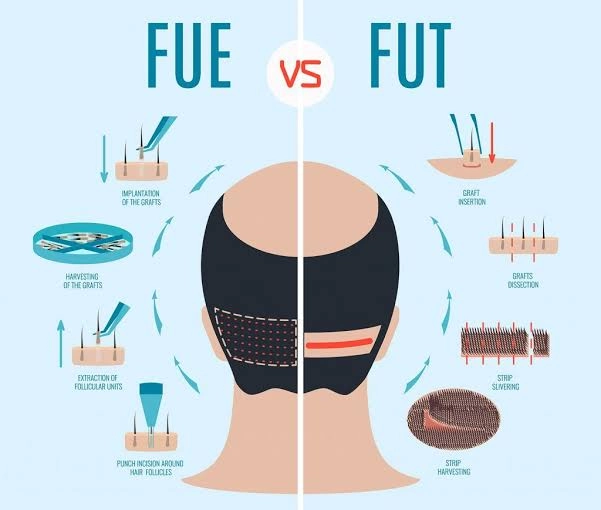
Hair transplant success is not only about restoring hair—it is about restoring density, natural appearance, and long-term stability. One of the most critical yet often misunderstood factors in hair restoration is graft yield. When comparing FUT vs FUE graft yield in Dubai, patients are essentially comparing how efficiently each technique harvests and preserves healthy hair follicles from the donor area while maximizing cosmetic density in the recipient zone.
While both Follicular Unit Transplantation (FUT) and Follicular Unit Extraction (FUE) are highly effective, they differ significantly in how grafts are harvested, how the donor area is utilized, and how much usable graft density can be achieved in a single or multiple sessions. Understanding these differences is essential for choosing the right procedure based on individual hair loss patterns, donor capacity, and long-term restoration goals.
This guide provides a detailed, medically informed breakdown of FUT vs FUE graft yield in Dubai, focusing on donor architecture, harvesting efficiency, and expected outcomes.
FUT vs FUE Graft Yield in Dubai: Understanding the Core Concept
Graft yield refers to the number of viable hair follicles successfully extracted, preserved, and transplanted into thinning or bald areas.
When evaluating FUT vs FUE graft yield in Dubai, it is important to understand three key components:
- Donor area capacity
- Extraction efficiency
- Graft survival rate
Both techniques aim to maximize these factors, but they achieve them differently.
Why Graft Yield Matters
Higher graft yield can contribute to:
- Better density restoration
- More complete coverage of bald areas
- Reduced need for multiple surgeries
- Improved cosmetic outcomes
However, higher yield must always be balanced with donor area preservation.
Donor Area Architecture: The Foundation of Graft Yield
The donor area—typically the back and sides of the scalp—is genetically resistant to hair loss and serves as the source of transplanted follicles.
Understanding Donor Density
Donor density varies among individuals and influences:
- Number of available grafts
- Harvesting strategy
- Long-term donor preservation
Patients with strong donor density typically achieve better graft yields in both FUT and FUE procedures.
Donor Zone Limitations
Even in ideal cases, the donor area is finite. Overharvesting can lead to:
- Visible thinning
- Patchy appearance
- Reduced future transplant options
This is why surgical planning is critical in FUT vs FUE graft yield in Dubai decisions.
FUT vs FUE Graft Yield in Dubai: How FUT Maximizes Yield
Follicular Unit Transplantation (FUT) is often associated with higher graft yield in a single session.
How FUT Harvesting Works
FUT involves:
- Removing a thin strip of scalp from the donor area
- Dissecting follicular units under magnification
- Preparing grafts for implantation
Because the donor strip is harvested in a continuous section, a large number of follicles can be collected efficiently.
Balancing Yield With Donor Preservation
A critical concept in FUT vs FUE graft yield in Dubai is sustainability.
Why Donor Preservation Matters
Overharvesting can permanently reduce:
- Future transplant options
- Scalp uniformity
- Long-term aesthetic flexibility
Strategic Planning
Experienced surgeons often:
- Combine FUT and FUE in select cases
- Stage procedures over time
- Preserve donor reserves carefully
Long-Term Results and Density Sustainability
What Determines Long-Term Success?
- Donor management strategy
- Graft survival rate
- Hair loss progression
- Maintenance treatments
Both FUT and FUE can provide long-lasting results when properly planned.
Common Misconceptions About Graft Yield
Myth 1: FUE Always Gives More Grafts
Not true—FUT often provides higher single-session yield.
Myth 2: Higher Grafts Always Mean Better Results
Quality and placement matter more than numbers alone.
Myth 3: Donor Area Can Regenerate
Donor hair does not regenerate after extraction.
Why Dubai Is a Leading Destination for Hair Transplant Procedures
Dubai has become a global hub for advanced hair restoration.
Advanced Surgical Expertise
Many clinics offer:
- High-volume graft procedures
- Advanced extraction technology
- Customized treatment planning
Patient-Centered Approach
Focus is placed on:
- Natural density design
- Donor preservation
- Long-term outcomes
Advantages of FUT Graft Yield
FUT may offer:
- Higher graft numbers per session
- Greater efficiency in dense donor areas
- Reduced transection rate in skilled hands
- Optimal use of donor strip architecture
This makes FUT particularly suitable for patients with advanced hair loss.
Yield Efficiency in FUT
Because the strip contains a concentrated band of follicles, FUT can often achieve:
- Higher follicular density extraction
- Less wastage of viable grafts
- Strong survival rates when properly handled
In many cases, FUT provides one of the highest single-session yields available in hair restoration surgery.
FUT vs FUE Graft Yield in Dubai: How FUE Differs
Follicular Unit Extraction (FUE) harvests individual grafts directly from the donor area.
How FUE Harvesting Works
FUE involves:
- Extracting individual follicular units
- Using micro-punch tools
- Distributing extraction across the donor zone
This method avoids a linear incision but changes the dynamics of graft yield.
Advantages of FUE Yield Strategy
FUE allows:
- Selective harvesting across a wider area
- Reduced visible linear scarring
- Flexible donor management
- Multiple session planning
Yield Characteristics in FUE
While highly effective, FUE may:
- Require more time to harvest large graft numbers
- Be limited by donor density distribution
- Depend heavily on extraction precision
Overharvesting in FUE can reduce donor quality if not carefully planned.
FUT vs FUE Graft Yield in Dubai: Comparative Breakdown
Understanding the differences between FUT and FUE requires evaluating key performance factors.
1. Total Graft Output
- FUT: Typically higher yield in a single session
- FUE: Moderate to high yield depending on donor availability
2. Donor Area Utilization
- FUT: Concentrated harvesting from strip region
- FUE: Diffuse extraction across donor zone
3. Graft Survival Rate
Both methods can achieve high survival rates when performed correctly, but:
- FUT may offer slightly more consistent graft integrity in some cases
- FUE relies heavily on extraction technique precision
4. Session Planning
- FUT: Often fewer sessions needed for high graft counts
- FUE: May require multiple sessions for extensive coverage
Hairline Density and Aesthetic Outcomes
Graft yield directly impacts hairline design and density outcomes.
High-Density Requirements
Patients requiring:
- Advanced hairline restoration
- Crown coverage
- Extensive bald area correction
often need higher graft yields.
Strategic Placement
Surgeons must balance:
- Density in frontal regions
- Natural transition zones
- Donor preservation
In FUT vs FUE graft yield in Dubai, planning is more important than technique alone.
Donor Area Appearance After FUT and FUE
Donor aesthetics play a major role in procedure selection.
FUT Donor Characteristics
FUT may result in:
- Linear scar formation
- Concealable scar with longer hair
- Strong remaining donor density above and below scar
FUE Donor Characteristics
FUE typically results in:
- Tiny scattered extraction points
- Minimal visible scarring
- Potential for over-thinning if poorly managed
Donor preservation strategy is essential for both techniques.
Graft Quality and Transection Rates
Graft quality directly influences survival and final density.
FUT Graft Quality
- Harvested under direct visualization
- Lower transection risk in skilled hands
- Strong follicular integrity
FUE Graft Quality
- Dependent on punch size and extraction skill
- Risk of partial follicle transection if not performed precisely
- Requires advanced surgical expertise
Ideal Candidates for FUT vs FUE Graft Yield in Dubai
Patient selection plays a major role in determining outcomes.
FUT May Be Ideal For:
- Advanced hair loss cases
- Patients needing maximum graft numbers
- Individuals not concerned about linear scar
- Those preferring fewer sessions
FUE May Be Ideal For:
- Patients wanting short hairstyles
- Those prioritizing minimal visible scarring
- Moderate hair loss cases
- Patients preferring staged procedures